


10 Jun Deep Dive into Playfina’s Banking Algorithms: Withdrawal Speed & Security Analyzed
Navigating the technical architecture of a modern online casino requires understanding its core operational frameworks, from payment gateways to random number generators. Playfina online casino presents a compelling case study, merging a licensed Curacao platform with a market-specific approach for Australian players. This whitepaper deconstructs its ecosystem, providing a technical manual for efficient and secure engagement with the playfina casino online environment, covering everything from cryptographic login protocols to the mathematics of bonus conversion.
Pre-Engagement Technical Checklist
Before initiating the playfina casino login sequence, verify these system and compliance parameters to ensure optimal performance and regulatory safety.
- Jurisdictional Compliance: Confirm your physical location is within a territory where the Curacao eGaming license held by Playfina is recognized and operational.
- Connection Security: Ensure your network uses TLS 1.2 or higher. The platform’s SSL certificate (typically 256-bit encryption) must be valid and unexpired when accessing the site.
- Financial Instrument Pre-Verification: Prepare a primary withdrawal method (e.g., bank card, e-wallet). Note that some issuers may block gambling transactions; pre-authorization checks are advised.
- Device Compatibility Audit: Test browser compatibility (Chrome 90+, Safari 14+) or allocate storage (approx. 80-150MB) for the native application if mobile-centric use is planned.
- Documentation Readiness: Have digital copies of government-issued ID and a recent utility bill (≤3 months old) for the mandatory KYC (Know Your Customer) verification pipeline.
Account Initialization: Protocol & Data Flow
The registration at playfina casino is a standard API-driven process. The technical steps involve data submission, validation, and session creation.
- Endpoint Access: Navigate to the registration modal, typically served from a `/signup` endpoint.
- Data Packet Submission: Input mandatory fields: email (validated via regex), password (hashed client-side before transmission), currency (AUD locked for AU domain), and optional promo code.
- Verification Handshake: A confirmation link is sent via SMTP to the provided email. Clicking this link completes the handshake, verifying email ownership and activating the account.
- Session Initialization: Upon first playfina casino login, a session token is generated and stored in your browser’s local storage, facilitating persistent authentication for a defined period.
Mathematical Modeling of Bonus Conversion
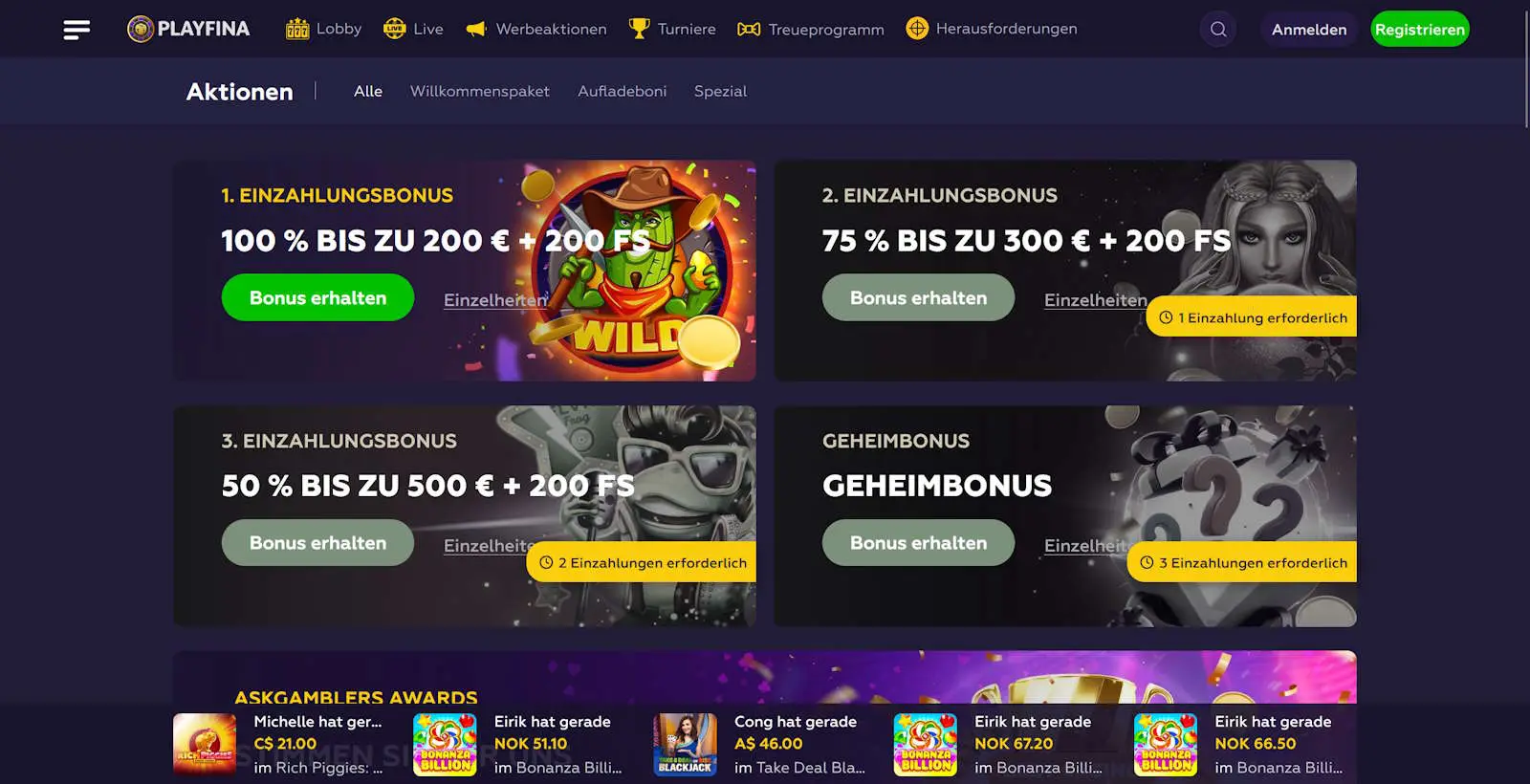
Bonuses are essentially leveraged play credits with strict conversion rules. Understanding the underlying math is critical. Assume a welcome offer of 100% up to $500 + 200 Free Spins, with a 40x wagering requirement (WR) on the bonus amount.
- Scenario: Deposit $200, receive $200 bonus. Total balance: $400 (subject to WR).
- Wagering Obligation: $200 (bonus) x 40 = $8,000 must be wagered before withdrawal.
- Game Contribution Weighting: This is the critical variable. If you play slots (100% contribution), every $1 bet counts as $1 toward WR. If you play table games like blackjack (5% contribution), a $10 bet counts only as $0.50 toward the $8,000 goal. This drastically extends the playthrough.
- Expected Loss Calculation: Using a hypothetical slot with 96% RTP, the expected loss on $8,000 wagered is $8,000 * (1 – 0.96) = $320. Since the bonus was $200, the expected net position is negative (-$120) before completing wagering, highlighting the risk.
- Strategic Implication: Focus on high-RTP, 100%-weighted games to minimize variance and expected loss during wagering. Avoid table games for clearing bonus funds due to low contribution rates.
| Parameter | Specification | Technical Implication |
|---|---|---|
| Licensing Authority | Curacao eGaming (Master License) | Defines regulatory framework, dispute resolution path, and operational mandates. |
| RNG Certification | Independent audit (iTech Labs, etc.) | Ensures game outcome randomness and fairness; check for certificate expiry. |
| Average Payout Speed | 0-24 hours (E-wallets), 1-3 days (Cards/Bank) | Indicates efficiency of back-end processing and anti-fraud check automation. |
| Withdrawal Limit | $7,500 per week | A liquidity management parameter; impacts high-stakes player cashflow. |
| Game Client | HTML5 (Web), Native APK/iOS App | Ensures cross-platform compatibility without Flash or Java dependencies. |
| Supported Cryptography | SSL 256-bit, Optional 2FA | Protects data in transit during playfina casino login and financial transactions. |
Financial Network Architecture: Deposits & Withdrawals
Playfina’s banking module integrates multiple payment service providers (PSPs). The technical workflow involves authorization, settlement, and clearance phases.
- Deposit Flow: User selects method -> redirected to PSP’s secure iFrame/API -> transaction authorized -> PSP sends confirmation callback to Playfina’s server -> balance updates instantly (excluding POLi/PayID, which may have bank-side delays).
- Withdrawal Flow: User requests payout -> internal fraud check triggers -> if approved, request is queued for processing -> funds are sent via same method (where possible) using a reverse transaction ID -> user receives funds after PSP and bank processing times.
- Key Insight: Speed is determined by the slowest node: casino processing, PSP batch times, and banking network hours. E-wallets are fastest due to closed-loop systems.
Security Protocols & Data Integrity
The playfina casino online platform employs a multi-layered security model.
- Encryption: All data packets are encrypted using TLS during transmission. Sensitive data (passwords) are hashed (bcrypt/scrypt) in the database.
- Account Security: Beyond the standard playfina casino login, enabling Two-Factor Authentication (2FA) adds a time-based one-time password (TOTP) layer, mitigating credential stuffing attacks.
- Game Integrity: Each game round’s outcome is determined by a server-side RNG seed, often provably fair in crypto casinos, though here it’s reliant on the auditor’s certification. Client-side graphics are merely a representation of the server-decided result.
Troubleshooting Common System Errors
Technical issues often stem from local configuration, network, or session conflicts.
- Error: “Invalid Login” Post-Credentials. Diagnosis: Cached credentials or corrupted session token. Resolution: Clear browser cache/cookies for the domain. Use “Forgot Password” to force a new credential set. Disable password managers temporarily.
- Error: Game Fails to Load (Stuck on Loading %). Diagnosis: Blocked WebSocket connection or missing asset. Resolution: Disable ad-blocker/extensions for the site. Ensure browser supports WebGL. Try a different browser to isolate the issue.
- Error: Deposit Successful but Balance Not Updated. Diagnosis: PSP callback delay or internal system lag. Resolution: Do not re-deposit. Wait 10-15 minutes. Check email for transaction receipt. Contact support with the transaction ID from your bank/e-wallet.
- Error: Withdrawal Request Automatically Cancelled. Diagnosis: Often fails automated anti-fraud or bonus rule checks. Resolution: Review bonus terms for unmet wagering. Ensure KYC is fully approved. Contact support for the specific technical reason logged in their system.
Extended Technical FAQ
Q1: What is the specific technical reason for the “same method” withdrawal rule?
A: It’s a fraud prevention measure. Requiring withdrawals to the source (or a verified equivalent) creates an auditable financial trail and complies with anti-money laundering (AML) regulations by preventing third-party cash-outs.
Q2: How does the game contribution percentage technically affect the wagering algorithm?
A: The system multiplies your bet amount by the game’s contribution coefficient (e.g., 0.05 for 5% blackjack). Only this product is deducted from your remaining wagering requirement. The algorithm tracks this in real-time in a dedicated database field for your bonus session.
Q3: Can I run multiple instances of the Playfina casino client simultaneously?
A: Technically, yes via different browsers or devices, but the system’s session management may flag this as suspicious activity, especially if playing the same game or funding from different sources concurrently. It is not recommended.
Q4: What happens to my session data if I switch from the web app to the native mobile app mid-game?
A: Game state is typically not preserved unless the game itself supports cloud save (rare for slots). Your monetary balance is server-side and will reflect correctly, but the specific game round will be forfeited.
Q5: Are the free spin winnings treated as bonus money or real money in the backend?
A: Almost universally, winnings from no-deposit free spins are tagged as “bonus money” with their own wagering requirement (e.g., 40x). The system creates a separate bonus wallet for these funds, governed by distinct rules from your cash deposit wallet.
Q6: What specific data points are verified during the KYC process?
A: The system uses automated OCR (Optical Character Recognition) to extract data from your ID document. It then cross-references: 1) Name match between ID and account, 2) DOB confirming legal age, 3) Document authenticity (holograms, fonts), 4) Address on utility bill vs. account profile, and 5) Liveliness check in selfie verification (if required).
Q7: Why might a perfectly correct playfina casino login still fail?
A: Beyond credentials, failures can be due to: IP address geolocation mismatch, attempted login from a VPN/proxy IP blacklisted by the casino’s security vendor, or an account temporarily locked after too many failed attempts (a brute-force defense).
Q8: How are Return to Player (RTP) percentages technically enforced by the casino?
A> The casino does not “enforce” RTP; it is a built-in mathematical parameter of the game software provided by the developer (e.g., Pragmatic Play). The casino licenses the game “as is.” The certified RTP is achieved over millions of spins via the game’s configured volatility and prize distribution tables.
Q9: What is the technical architecture behind “instant” e-wallet withdrawals?
A> The casino pre-funds a “hot wallet” with the e-wallet provider. When you request a payout, the system sends an API call to the provider to transfer funds from this hot wallet to your linked e-wallet account. This bypasses traditional banking networks, enabling sub-24-hour settlement.
Q10: If I encounter a game malfunction (e.g., game freezes on a win), what is the definitive source of truth for the outcome?
A> The definitive record is the game transaction log on the provider’s server, not the graphics on your screen. You must contact support with the Game ID, Transaction ID, and timestamp. They will request the log from the game provider to verify and manually credit any confirmed winnings.
Conclusion: A System Built for Informed Engagement
Playfina casino online operates on a standard but robust technical stack common to licensed iGaming platforms. Its value proposition for the Australian market is enhanced by local payment integrations. Success and security on the platform are less about luck and more about understanding the underlying systems: the mathematical models of bonuses, the data flow of payments, and the troubleshooting protocols for common errors. By approaching playfina casino with this technical manual in hand, players can transition from passive users to informed participants, optimizing their interaction with the platform’s digital architecture for a more controlled and transparent experience.
Sorry, the comment form is closed at this time.